Moving in Philadelphia presents a unique set of challenges found nowhere else. You are not just moving boxes; you are navigating narrow one-way streets, steep stoops, and historical architecture that was not built for modern furniture. The process demands specific knowledge of local geography and building quirks.
If you understand the layout of a standard rowhome or a tighter Trinity-style house, you can avoid damage to your belongings and the property.
This guide outlines exactly how to prep rowhouses for moves so the day proceeds without unnecessary stress.
What Parking Logistics Must You Handle Before the Truck Arrives?
Parking remains the single biggest hurdle for any move in Center City, Northern Liberties, or Fishtown. A large moving truck cannot double-park on a narrow street without blocking traffic for the entire block. You must secure a legal spot for the vehicle before the crew pulls up.
Secure a Temporary No-Parking Permit
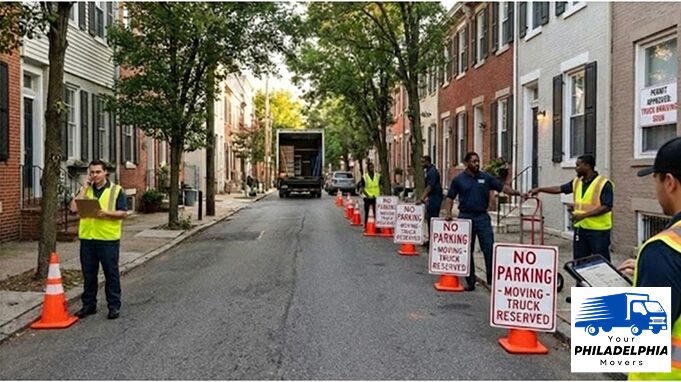
You can’t rely on finding an open spot on moving day. You need to apply for a Temporary No-Parking Permit from the streets department. This permit allows you to reserve forty feet of curb space. You should apply at least four days in advance to ensure you receive the signs on time.
Once you have the signs, the police district for your neighborhood must verify them. You must post these signs on trees or poles at your address at least twenty-four hours before the move begins. This gives neighbors time to move their cars. If a car remains in your spot on moving day, the police can ticket and tow it, provided you followed the posting rules.
You can apply for a Temporary No-Parking Permit here.
Plan the Route for a Box Truck
Many Philadelphia streets are barely wide enough for a sedan, let alone a twenty-six-foot moving truck. Some corners are too tight for a truck to turn. You must scout the approach to your home. Look for low-hanging tree branches or power lines that might snag the top of a truck. Check if your street has construction crews or road closures.
If you live on a particularly small street, like the numbered streets in South Philly or the smaller alleys in Old City, tell your moving company immediately. They might need to use a shuttle service. This involves parking the big truck on a main artery like Broad or Washington Avenue and using a smaller van to ferry items to the house.
Manage the “Savesies” Culture
Locals often use lawn chairs or cones to save parking spots, even though the city forbids it. If you did not get a permit, don’t assume moving a lawn chair is safe—this can cause conflict with neighbors.
The only way to guarantee a spot without risking an argument is the official permit. If you must load without a permit, have a friend sit in the driver’s seat of the truck at all times. They can circle the block if a SEPTA bus or emergency vehicle needs to pass.
How to Manage Narrow Entryways and Staircases
Rowhomes feature charming historical details, but these features often become obstacles during a move. The entryways usually include a vestibule with two doors, and the staircases are often steep and narrow.
Measure the Vestibule Door Swing
The vestibule is the small space between your front door and the inner door. In many rowhouses, these doors swing toward each other or do not open fully to 90 degrees. Measure the width of both door frames. Also, measure the depth of the vestibule itself. You need to know if a long sofa can stand up on its end and pivot through the space. If the measurement is too tight, you might need to remove the storm door or the main door from its hinges. Having a plan for this prevents a bottleneck at the front of the house.
Disassemble Large Furniture for Trinity Stairs
The Trinity rowhouse is famous for its three floors, comprising one room on each level, connected by a spiral or curved staircase. These stairs are the enemy of queen-size box springs and deep dressers. You must break down every piece of furniture that allows it. This includes:
- Removing legs from sofas and dining tables.
- Taking mirrors off dressers.
- Breaking down bed frames and headboards completely.
- Removing shelving from bookcases.
- Taking doors off large armoires.
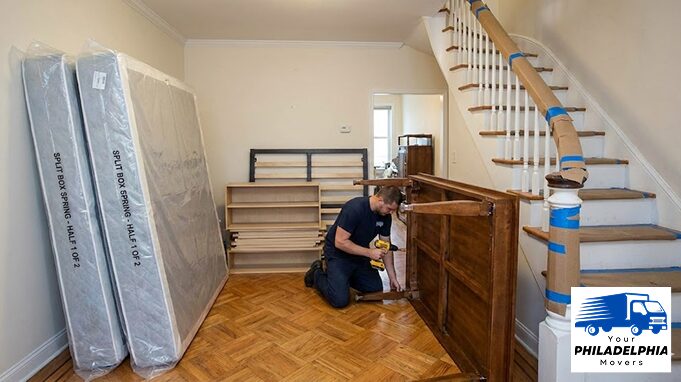
If you own a standard box spring, it likely will not fit up a Trinity staircase. You should purchase a split box spring, which comes in two pieces. If you try to force a standard one, you will likely damage the drywall or the staircase railing.
Protect the Banisters and Baseboards
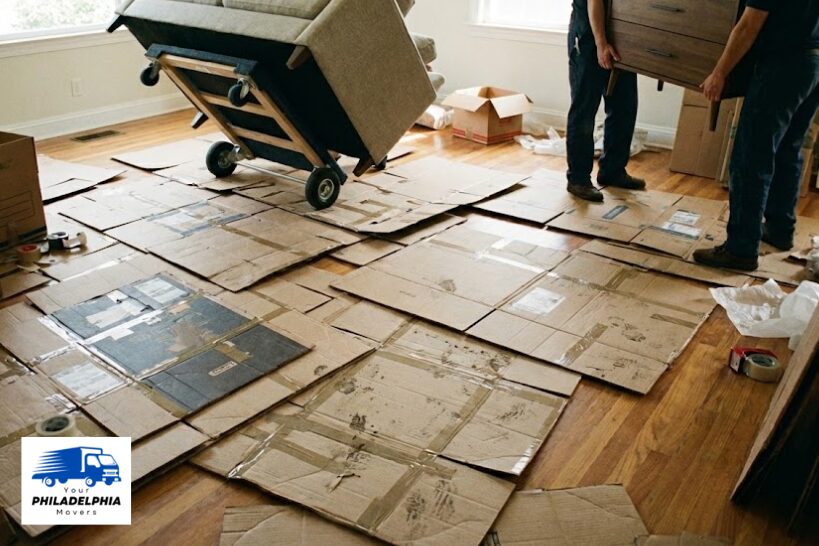
The tight turns in a rowhouse mean furniture will brush against the walls. You should apply protection before you start moving items. Use painter’s tape to secure cardboard or heavy blankets over the banisters, and consider floor protection rentals to safeguard hardwood, tile, and stair treads. This prevents scratches when the crew maneuvers heavy items around the turns. You can also tape cardboard along the lower section of the hallway walls to guard the baseboards and paint. This is much easier than patching plaster and repainting after the move is complete.

The Best Packing Strategies to Consider
Packing for a rowhouse move is different from packing for a suburban rancher. You’re moving vertically, not horizontally, which makes box size and weight far more important. Professional packing services help protect your belongings and make carrying items down multiple flights of stairs safer and more efficient.
Keep Boxes Light for Vertical Hauling
A large box filled with books is manageable on a flat surface, but it becomes a safety hazard on a steep staircase. Thus, you should keep your boxes small and light.
Use small boxes for heavy items like books, canned goods, and tools, and use medium or large boxes only for light items like pillows, linens, and lampshades.
Remember to tape the bottom of every box well. When a mover carries a box down a flight of stairs, the center of gravity shifts. A secure box prevents the contents from shifting and throwing the carrier off balance.
Stage Boxes on the Ground Floor
Do not leave all your boxes in the bedrooms on the second and third floors. If you have space, move completed boxes to the ground-floor living room before the movers arrive. This clears the hallways and bedrooms, giving the crew room to maneuver the large furniture pieces first.
Doing this also speeds up the loading process. The movers can create a chain to pass boxes out the door quickly.
If you cannot move them downstairs, stack them in the center of the room, away from the door and the path to the hallway.
Hire a Professional Packing Service
The most efficient way to handle a vertical move is to outsource all labor. Professional packers bring the specific supplies and stamina required to navigate narrow stairwells safely. Doing this eliminates the physical toll of climbing stairs for weeks before the truck even arrives.
What Exterior Obstacles Require Attention?
The exterior of a Philadelphia home often presents hazards that people overlook until they are carrying a heavy load. Prior to the move, you should:
- Clear the pavement. Inspect the sidewalk for loose bricks or concrete buckled by tree roots. Remove these tripping hazards or mark them clearly.
- De-ice the stoop. Philadelphia marble steps become incredibly slick when frozen. Shovel a wide path and apply salt heavily before the truck arrives.
- Remove railing clutter. Unlock bike racks and move planters so the movers can use the full width of the entrance and ramp.
- Prep windows for hoisting. Make sure the upper windows open fully and screens removed easily in case large furniture, like a sofa, requires a hoist.
Who Should You Trust With Your Rowhome?
Preparation solves half the puzzle. The execution requires a team that knows the difference between a vestibule and a bottleneck. You need residential movers who respect the age of your home and the quirks of your block.
We navigate these narrow streets daily. We know how to pivot furniture through tight corners without scratching the paint. Let us manage the heavy lifting and the parking logistics.
Contact us today to discuss your move and get an estimate for your rowhouse.